


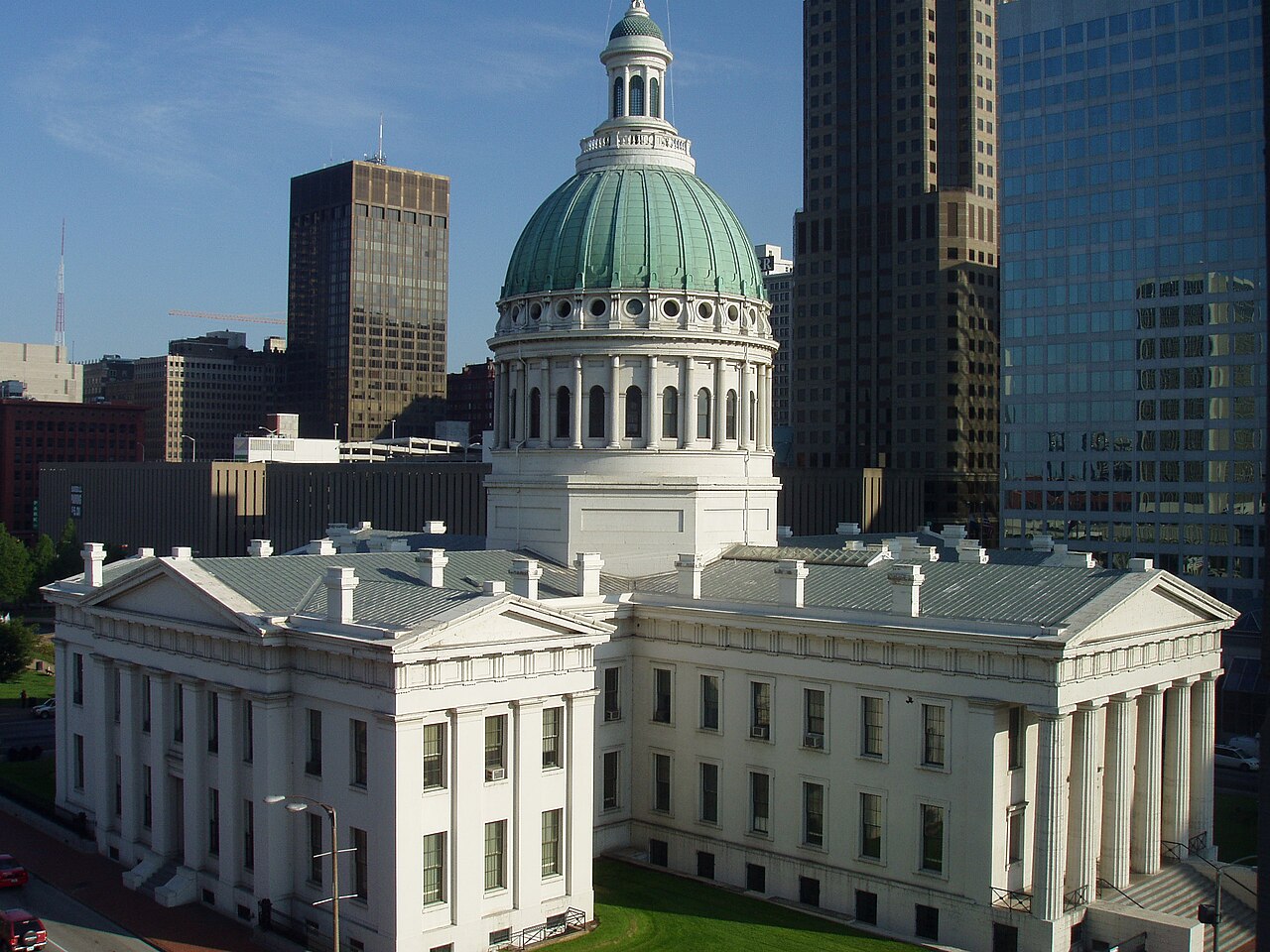
St. Louis carries a layer of history most residents pass without noticing, and few buildings hold as much of it as the Old Courthouse at the corner of 4th and Market Streets downtown. Its green cast-iron dome has watched over the city’s riverfront since the 1860s, and inside its courtrooms, one of the most consequential legal battles in American history unfolded decades before the Civil War. Understanding this building means understanding a foundational chapter of St. Louis, one that still shapes how the city and the country talk about citizenship and civil rights.
A Building Shaped by Decades of Change
The structure St. Louisans recognize today did not appear all at once. The original county courthouse on the site was completed in 1828, designed by the architectural firm Laveille & Morton in the restrained Federal style common to early American civic buildings.
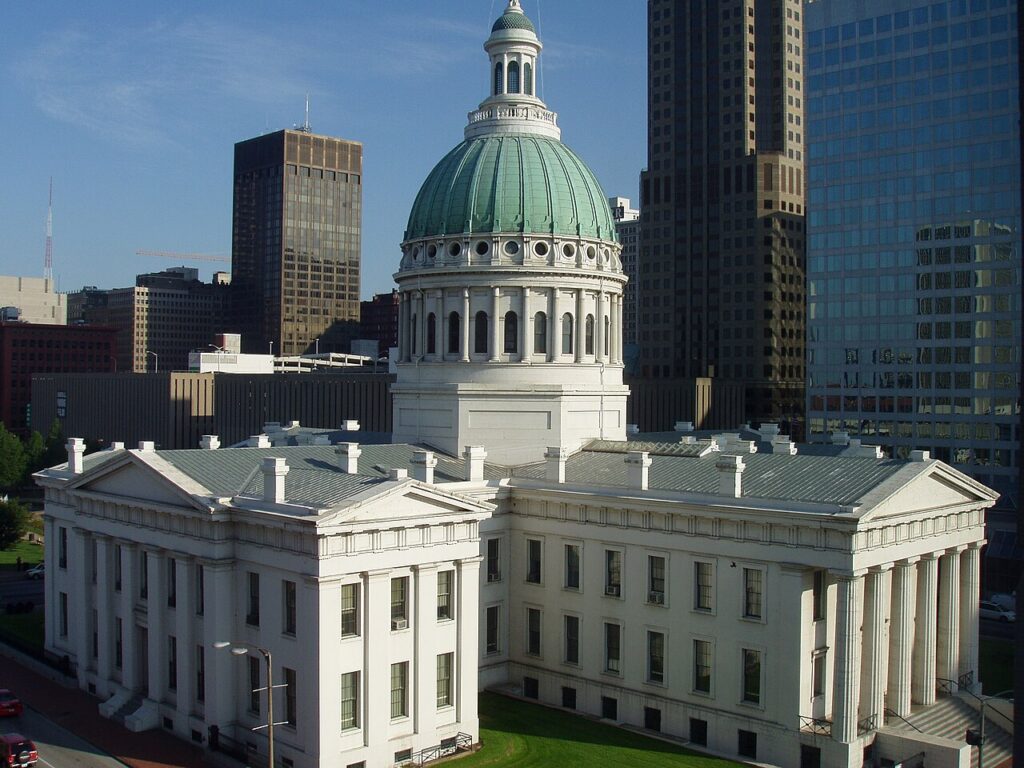
Architect Henry Singleton redesigned the building in the Greek Revival style beginning in 1839, and Robert S. Mitchell carried out further modifications starting in 1851. The most recognizable feature arrived later, when architect William Rumbold replaced the original cupola with an Italian Renaissance-style cast iron dome in 1861, completing the work by 1864. Notably, the original west-wing courtroom where the Scotts’ case was first heard no longer survives in its historical form; structural concerns in 1855 led workers to divide the space with a new corridor, according to the site’s visitor records.
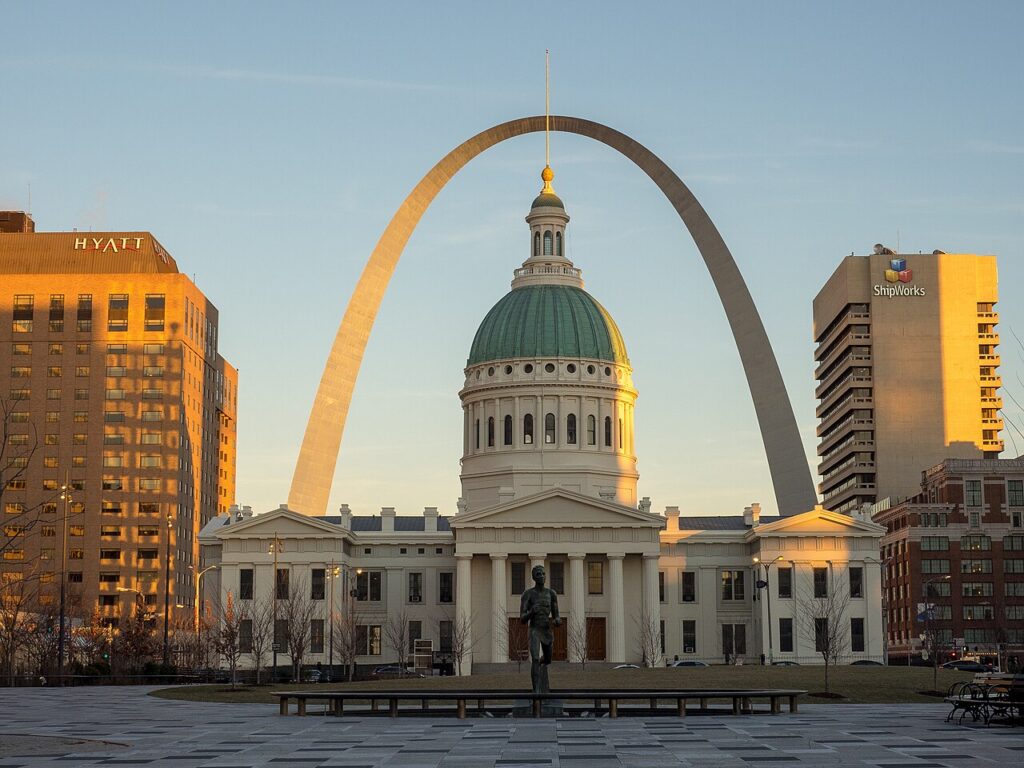
That dome remains a defining piece of the St. Louis skyline. Made of wrought and cast iron with a copper exterior, it stands as an engineering achievement of its era. Inside, four lunettes carry murals by artist Carl Wimar depicting pivotal moments in St. Louis history, painted over in 1880 and later restored in 1888.

The Dred Scott Case and Why It Started Here
Dred Scott was born enslaved in Virginia around 1800 and later brought to Missouri, where Dr. John Emerson purchased him. His travels with Emerson took him into free territory, including Illinois and the Wisconsin Territory, before he returned to St. Louis still enslaved. Beginning in 1846, Scott and his wife, Harriet, filed separate freedom suits in this courthouse, arguing that their years on free soil entitled them to freedom, a history traced in a detailed biography maintained by the State Historical Society of Missouri.
The Scotts won their case in 1850, but the Missouri Supreme Court reversed that ruling in 1852, denying their freedom despite the earlier precedent. The dispute eventually reached the United States Supreme Court as Dred Scott v. Sandford. On March 6, 1857, Chief Justice Roger Taney ruled that people of African descent could not be U.S. citizens and had no standing to sue in federal court, a decision that also struck down the Missouri Compromise’s limits on slavery’s expansion, as detailed in a research guide compiled by the Library of Congress.
Despite the ruling, the Scotts gained freedom months later. Taylor Blow, a member of the family that had once enslaved Scott, purchased and emancipated Dred and Harriet on May 26, 1857. Scott died of tuberculosis on September 17, 1858, roughly a year after becoming free. Historians widely regard the Supreme Court’s decision as one of the most consequential and criticized in American legal history, deepening the sectional conflict already building toward the Civil War.
What Visitors Can See Inside Today
The National Park Service preserves and interprets the building as part of Gateway Arch National Park, which also includes the Gateway Arch and the surrounding riverfront grounds. The courthouse now houses historical galleries and two restored period courtrooms that give residents a direct sense of the era surrounding the Scotts’ case.
The two preserved courtrooms represent different eras of the building’s use:
- Circuit Court #13, in the east wing, reflects a 1910 courtroom design.
- Circuit Court #4, in the west wing, is restored to its appearance from around the 1850s, closer to the period of the Dred Scott proceedings.
A statue of Dred and Harriet Scott stands near the building, a permanent marker connecting the space to the people whose fight for freedom took place inside it.
Why This History Matters for St. Louis Today
For residents of St. Louis, the Old Courthouse is not a distant historical footnote; it sits in the heart of downtown, visible from the riverfront and woven into daily civic life. The building’s role in the Dred Scott case connects directly to the city’s history as a border city where free and slave states met, a geography that shaped Missouri’s laws throughout the nineteenth century.
The courthouse’s continued preservation reflects a regional commitment to historical accuracy over comfortable narratives. That framing matters locally because St. Louis has spent decades reckoning publicly with how its history of slavery and segregation shaped the city’s neighborhoods and institutions, patterns still visible in the region today. That same instinct toward acknowledging the past and reinvesting in the community shows up elsewhere in the region, including in local organizations whose community commitment focuses on strengthening St. Louis neighborhoods.
St. Louis experiences a humid continental climate that has tested the courthouse’s cast iron dome and masonry for well over a century, with hot, humid summers and cold winters producing freeze-thaw cycles that make maintaining nineteenth-century materials a genuine engineering challenge. That the dome and courtrooms remain intact today reflects sustained restoration work responding to those regional conditions.
The Old Courthouse endures as a place where St. Louis residents can stand near the same rooms where a fight for basic human freedom was argued, decided against, and ultimately vindicated by the constitutional changes that followed the Civil War.